
Hi everyone,
I'm Yash, the maintainer of Breakscale, and I'm excited to share it here as part of the Vercel Open Source Program.
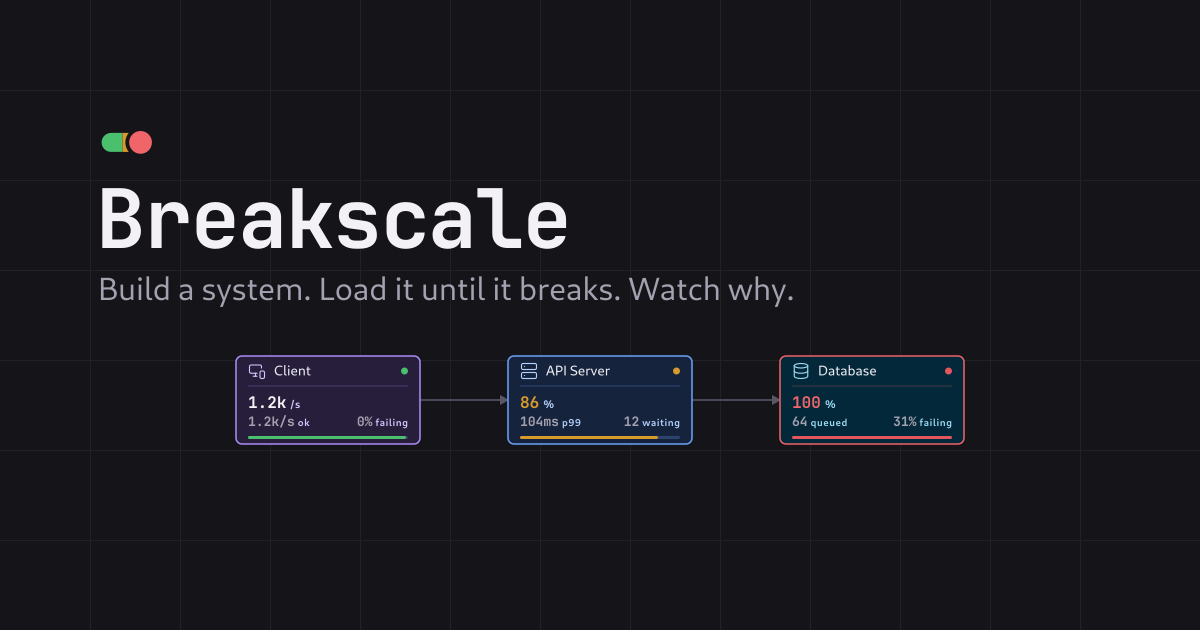
Breakscale is an open-source system design simulator where every number is measured.
You drop load balancers, caches, databases, queues and about 29 other components on a canvas, wire them into a system, and drag the traffic up until something gives. What you watch while it happens is a real discrete-event simulation: latency percentiles climbing, queues filling, circuit breakers tripping, whole systems collapsing into retry storms. All of it comes from individual simulated requests rather than being drawn to look plausible.
That distinction is the whole project. Most system design tools are diagramming tools with animations on top. If a number in Breakscale looks wrong, it's because the system is wrong, not because the animation is.
The example I always show people
100 requests a second going in. The database sits at 99.9% busy. Goodput is zero.
The reason is that retries turned those 100 offered requests into 348 hitting a database that was already full. Every client politely retrying made it worse. It's a failure mode people can describe in interviews and still not quite believe until they watch it happen in front of them.
Where it runs
Breakscale runs in three places:
- In the browser at breakscale.tech

- Inside VS Code, as an extension
- Inside your AI assistant, through an MCP server; which means Claude can read your actual code, draw the architecture it finds, run it under load, and tell you where it breaks
The MCP server is the part I've had the most fun with. Going from "here's my repo" to "here's what happens to it at 10k requests a second" without leaving the conversation turns out to be a genuinely different way to reason about a design.
Under the hood
React, TypeScript and Vite. The canvas is hand-rolled SVG and the charts are drawn directly rather than pulled from a charting library, which keeps the bundle small and the rendering predictable. The simulation engine is a min-heap event queue; no frameworks, since the whole point is that I can account for every number it produces.
The project recently passed 1,200 GitHub stars, and contributions have been a big part of how it's grown.
Being part of the Vercel Open Source Program helps me keep the web infrastructure around it running; the app itself, the docs, and the hosted MCP server.
Project: https://breakscale.tech GitHub: https://github.com/xevrion/breakscale
I'd love to hear from anyone who has taught or interviewed on system design: which failure modes do you find hardest to get across in words, and would seeing them actually happen help?